Jun 8, 2026
Helping Admissions Teams Support Transfer Students Earlier
In The News
Insights
Expanding transcript intelligence capabilities to support earlier transfer guidance
Transfer remains one of the most complex and least transparent pathways in higher education.
Every year, millions of students consider transferring institutions as they look for programs that better align with their academic goals, financial needs, or long-term career plans. Before deciding where to apply, transfer students are often trying to answer a few critical questions:
Will my credits transfer?
How much time will it take to graduate?
What will my degree path look like?
What will it actually cost?
For many students, those answers do not come early enough to meaningfully influence their decision-making process.
Why Transfer Guidance Often Comes Too Late
At many institutions, meaningful transfer guidance is typically only available after a student applies or is admitted. This creates a significant challenge for both students and admissions teams.
Students are often expected to commit time, effort, and sometimes application fees before understanding how their previous coursework may apply toward a degree. At the same time, admissions teams are expected to engage students earlier while managing growing transcript volume and increasingly complex workflows.
Part of the challenge is operational. Before institutions can provide transfer guidance, transcripts often must be manually reviewed and interpreted. Teams may need to:
Read inconsistent transcript formats
Extract course names, credits, and grades manually
Compare coursework against institutional requirements
Apply institutional policies across multiple systems
These workflows take time and are difficult to scale, especially as transcript submissions increase earlier in the admissions funnel.
The result is a process that can create delays, limit visibility, and make it difficult to provide timely guidance when students are actively making enrollment decisions.
Why This Matters Now
More institutions are beginning to accept unofficial transcripts earlier in the admissions process as a way to reduce friction and encourage student engagement.
While this creates a better experience for students, it also changes the demands placed on admissions teams.
Institutions are receiving:
More transcript submissions
More transfer inquiries
More requests for earlier guidance
The traditional approach to transcript review and transfer workflows was not designed for this level of speed or scale.
As transfer recruitment becomes more competitive, institutions that can provide earlier insight and clearer guidance may be better positioned to engage and convert prospective students.
How Structured Academic Data Supports Earlier Transfer Guidance
One of the biggest limitations in transfer workflows is that transcripts are still largely treated as static documents rather than structured data.
PDF transcripts often require manual interpretation before institutions can understand:
Coursework completed
Credit values
Grades earned
Potential alignment with institutional requirements
That model creates bottlenecks and slows down the ability to provide guidance earlier in the process.
When transcript data becomes structured and standardized, admissions teams can access information more quickly and consistently. This can help support:
Earlier transfer guidance workflows
Faster transcript review
More informed admissions conversations
Improved visibility into coursework and academic history
Structured academic data creates opportunities for institutions to move transfer-related conversations earlier in the student journey without relying entirely on manual processes.
How MyDocs Supports Transfer-Focused Admissions Workflows
Built on FirstLook and MAPit™, MyDocs is expanding transcript intelligence capabilities to support transfer-focused admissions workflows.
MyDocs transforms transcripts into structured academic data that can help institutions:
Review transcripts earlier in the process
Support transfer guidance workflows
Reference institutional catalogs and transfer rules
Generate preliminary transfer guidance reports
Reduce manual transcript data entry
The workflow is designed to support how admissions teams already operate:
A student uploads or submits a transcript, official or unofficial
MyDocs extracts and structures course-level academic data
Institutions can reference transfer rules, catalogs, and course mappings
A preliminary transfer guidance report can be generated to support earlier review and conversations
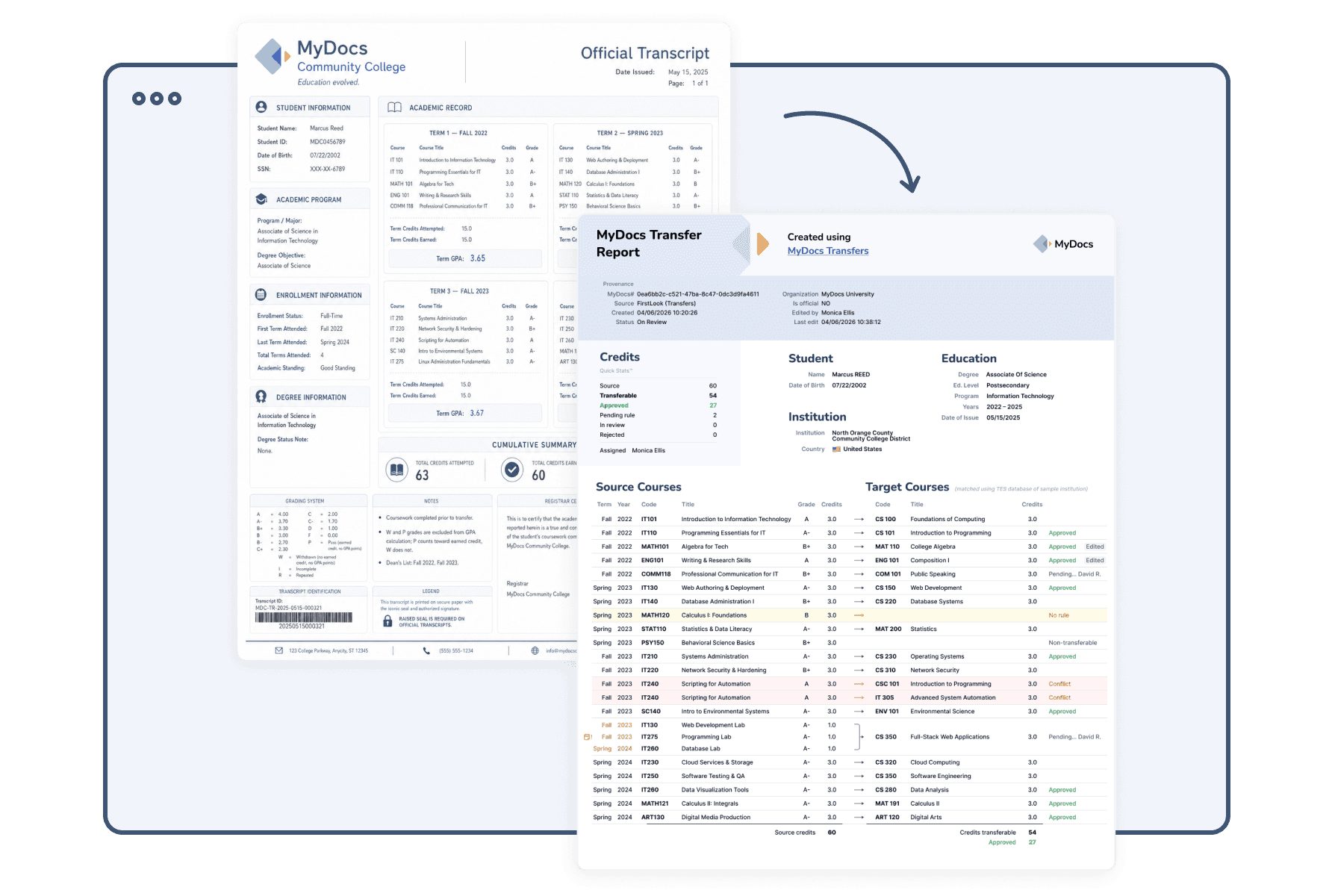
Rather than replacing institutional decision-making, these capabilities are designed to help admissions teams access transcript insights faster and engage students earlier in the process.
What Earlier Transfer Guidance Makes Possible
When institutions can provide transfer insight earlier, the impact can extend across the admissions experience.
For Students | For Admissions Teams | For Institutions |
Better visibility into how coursework may apply | More informed conversations with transfer prospects | More scalable transfer workflows |
Earlier understanding of degree pathways and timelines | Faster access to transcript insights | Improved consistency across transcript review |
Greater confidence in enrollment decisions | Reduced manual transcript handling | Better support for growing transfer volume |
Clearer expectations around transfer outcomes | Ability to engage students earlier in the funnel | Earlier insight across the admissions process |
Supporting Transfer Workflows Across the Admissions Process
Transfer is only one part of a broader shift happening across admissions.
Institutions are increasingly looking for ways to use transcript data more strategically across all student populations, including first-year, transfer, international, and post-secondary learners.
As transcript volume grows and expectations for faster, more personalized guidance continue to increase, structured academic data will play an increasingly important role in helping admissions teams operate more efficiently and engage students earlier in the process.
MyDocs continues to expand transcript intelligence capabilities to support evolving admissions workflows and help institutions unlock more value from academic data throughout the student journey.
Learn more about our transfer-focused capabilities here: https://go.mydocs.global/transfer

In The News
Can Your Transcript Process Keep Students Moving During Peak Season?
Learn what admissions teams need from modern transcript processing before peak season, from AI-powered data extraction and GPA normalization to human review, CRM-ready outputs, and faster decisions for students.
Sep 10, 2026

In The News
Faster Transcript Review, Stronger Admissions Workflows: JWU + MyDocs Webinar Recap and Q&A
Explore key takeaways and unanswered Q&A from the Johnson & Wales University + MyDocs webinar on faster transcript review, structured academic data, and smarter admissions workflows.
Aug 6, 2026

In The News
Transcript Processing Software for Higher Ed: What Admissions Teams Should Look For
Learn what admissions teams should look for in transcript processing software, from AI data extraction and GPA normalization to Slate integration, transfer insight, and international transcript support.
Jul 7, 2026

In The News
What Is Admissions Inefficiency Costing You?
Learn how manual transcript review affects admissions costs, staff capacity, timelines, and the case for improving admissions workflow efficiency.
Apr 23, 2026

In The News
Why Transfer Workflows Struggle to Provide Earlier Insight
Explore why transfer workflows remain slow and manual, and how structured transcript data helps admissions teams provide earlier transfer insight.
May 7, 2026

In The News
What’s Missing From Most Enrollment Marketing Strategies? Academic Insight.
See how structured transcript data helps enrollment marketers improve segmentation, personalization, student engagement, and academic-fit outreach.
Feb 24, 2026